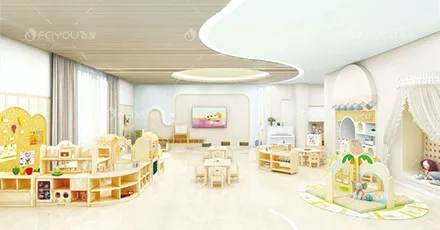
A fire alarm sounds. Twenty young children are scattered across the classroom—some at the art table, some in the reading corner, some still waking from nap time. The staff has practiced drills, but the physical environment itself will determine whether those drills translate into a fast, safe evacuation. Will the path to the exit be clear? Will stacked chairs topple and block the way? Will heavy shelving that was never anchored become a hazard during the rush?
Emergency preparedness in early childhood settings extends far beyond written plans and monthly drills. The furniture you choose and how you arrange it directly affect evacuation speed, child safety, and staff effectiveness during a crisis.
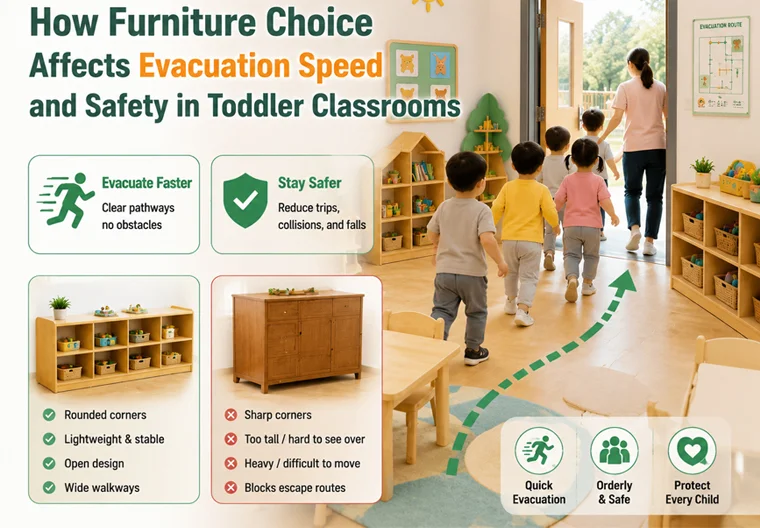
This guide examines the relationship between furniture decisions and emergency outcomes, drawing on academic research, regulatory requirements, and practical safety guidelines.
What the Research Says — Furniture Layout Directly Affects Evacuation Time
Recent academic research confirms what experienced educators have long suspected: classroom furniture layout significantly impacts how quickly children can evacuate during an emergency.
A 2025 study published in the China Safety Science Journal used controlled experiments and numerical simulations to examine how classroom structure affects evacuation efficiency for young children aged 6–7. The researchers found that appropriate evacuation routes and desk layouts can significantly reduce evacuation time. For classrooms on one side of a corridor, increasing corridor and exit width proved most effective. For classrooms on both sides, the internal corridor structure—including corridor count and intersections—emerged as the most critical factor.
Another 2025 study published in Progress in Disaster Science analyzed CCTV footage from ten real-world evacuation drills involving 742 six-to-seven-year-olds. The findings are striking:
| Finding |
Implication for Furniture Choice |
| Seating location strongly affected which exit students chose in rooms with two exits |
Furniture placement can inadvertently channel children toward one exit, creating bottlenecks |
| Teacher presence accelerated response times |
Clear pathways allow teachers to reach and guide children faster |
| School corridors were the most critical space affecting evacuation |
Furniture stored in corridors creates a major bottleneck risk |
The study also found that collaborative seating and strategic design—like exit placement—were key to improving evacuation routes and safety. This means that how you group tables and chairs is not just a pedagogical decision; it is a safety decision.
What this means for your program: The physical layout of your classroom is not neutral. Every piece of furniture either supports or hinders evacuation. A layout that feels functional during daily operations may create dangerous bottlenecks during an emergency.
How Furniture Choice Affects Evacuation — Four Critical Mechanisms
Furniture affects evacuation safety through four distinct mechanisms. Understanding each helps you make informed purchasing and placement decisions.
1. Evacuation route clearance
The most direct way furniture affects evacuation is by blocking or narrowing escape routes. Oregon administrative rules explicitly require that “doorways, evacuation routes, and exits must be kept free of materials, furniture, equipment, and debris to allow unobstructed access to the outdoors”. Providers must complete a daily inspection to ensure routes remain clear.
Similarly, Colorado regulations state that “evacuation equipment must not block exit routes” and that “nothing may be stored in or under any evacuation equipment”. Evacuation equipment must be located in the room or immediately outside the interior classroom door, labeled for easy identification, and ready for use.
2. Furniture stability during evacuation
During an emergency, children and staff move quickly. Unanchored furniture can tip over, creating additional hazards. The U.S. Consumer Product Safety Commission (CPSC) reports that from 2013 to mid-2023, 217 tip-over fatalities were reported, with 71% of those killed being children ages one to three.
The National Resource Center for Health and Safety in Child Care and Early Education (NRK) notes that CPSC reported 134 tip-over related deaths involving children five years old or younger from 2000 through 2006, with an estimated 16,300 children treated in emergency rooms for tip-over injuries in 2006 alone.
Georgia’s Department of Early Care and Learning requires that “all equipment and furniture that is of a weight or mass that could cause injury from tipping, falling, or being pulled or pushed over” must be secured. The regulation explicitly lists bookcases, shelving, and cabinets as items requiring securing, while noting that child-sized tables and chairs are not required to be secured.
3. Stacked furniture as an evacuation obstacle
Stackable furniture offers space efficiency but introduces unique evacuation risks. During an emergency, stacked chairs can:
-
Topple into evacuation routes, creating obstacles
-
Require additional time to navigate around
-
Injured children who collide with unstable stacks
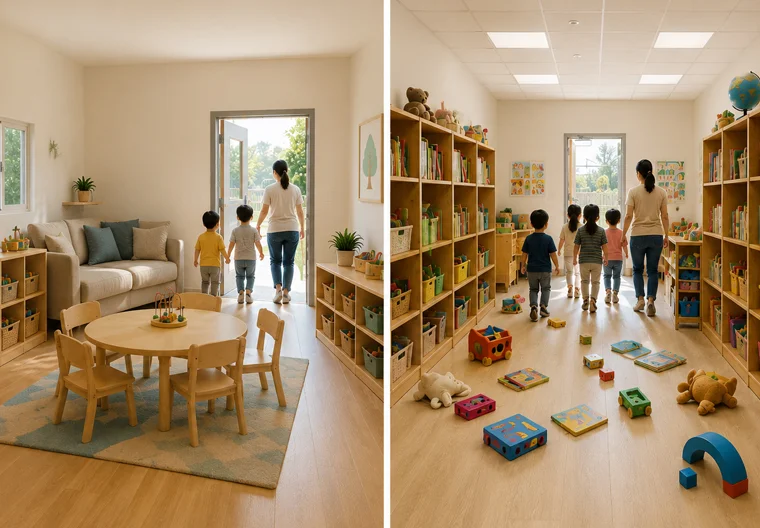
Safety guidelines for small daycare classrooms emphasize that “clear pathways at least 36 inches wide dramatically reduce child collisions and tripping incidents”. When stacked furniture narrows these pathways, evacuation speed suffers.
4. Teacher sightlines and supervision
During an emergency, teachers need to see every child instantly. Furniture that creates blind spots—tall shelving, corner cabinets, or poorly placed room dividers—delays the moment when a teacher can account for all children. The NRK guidelines state that “equipment and furnishings should be arranged so that a caregiver/teacher can easily view the children from different positions in the room”. This principle becomes critical during the chaos of an actual emergency.
What this means for your program: Every furniture decision has an evacuation implication. Lightweight, easily movable furniture is preferable in evacuation zones. Heavy furniture must be anchored. Storage should never encroach on pathways. And sightlines must remain clear from multiple teacher positions.
Regulatory Requirements — What the Law Requires
Several jurisdictions have codified furniture-related evacuation requirements into law. Understanding these requirements helps you evaluate your program’s compliance.
Oregon (Family Child Care Homes): Doorways, evacuation routes, and exits must be kept free of materials, furniture, equipment, and debris. Daily inspections are required. Fire drills must be practiced monthly, with providers expected to demonstrate full evacuation within three minutes.
Colorado (Child Care Centers): Evacuation equipment must not block exit routes. For every five infants, there must be at least one piece of sturdy mobile equipment for evacuation. Evacuation equipment must fit through doorways, be labeled for easy identification, and be ready for use.
Arizona (Infant Care): Evacuation cribs must be stored not more than ten feet from the exterior exit. This specific distance requirement ensures that staff can access evacuation equipment without navigating through furniture-obstructed spaces.
Georgia (Child Care Learning Centers): All equipment and furniture that could cause injury from tipping, falling, or being pulled over must be secured. Acceptable securing methods include furniture anchor straps, L-brackets, anti-tip kits, and drywall anchors.
General CPSC guidance: The CPSC’s “Anchor It!” campaign recommends anchoring all entertainment units, TV stands, bookcases, shelving, and bureaus using appropriate hardware. The agency also advises removing items that might tempt children to climb, such as toys and remote controls, from the top of furniture.
For programs seeking professional guidance on safety audits and furniture anchoring, detailed planning resources are available to support your facility decisions, including safety inspection checklists and anchoring guidance.
Furniture-Specific Evacuation Considerations
Different furniture types present different evacuation considerations. Use this framework when evaluating existing or potential purchases.
Tables
| Consideration |
Evacuation Impact |
Recommendation |
| Fixed vs. folding |
Fixed tables create permanent obstacles; folding tables can be moved |
In evacuation zones, choose folding tables that can be quickly collapsed |
| Table placement |
Tables near exits create bottlenecks |
Maintain 36-inch clearance from all exits |
| Table weight |
Heavy tables cannot be moved during emergency |
Choose lightweight materials for multi-purpose rooms |
Chairs
| Consideration |
Evacuation Impact |
Recommendation |
| Stackable chairs |
Can topple or block routes if stacked during emergency |
Never store stacked chairs in evacuation paths |
| Fixed chairs |
Permanent fixtures that cannot be moved |
Position to maintain clear pathways |
| Chair quantity |
Too many chairs reduce available floor space |
Store excess chairs outside evacuation zones |
Storage units (shelving, cabinets, bookcases)
| Consideration |
Evacuation Impact |
Recommendation |
| Anchoring |
Unanchored units tip during emergencies |
Anchor all units over 30 inches tall |
| Height |
Tall units block sightlines |
Keep under 48 inches or position along walls |
| Placement |
Units near exits create bottlenecks |
Never place storage within 36 inches of exits |
Evacuation-specific equipment
Some furniture serves dual purposes. Evacuation cribs, for example, are designed for both daily sleep routines and emergency evacuation. Colorado requires that for every five infants, there must be at least one piece of sturdy mobile equipment for evacuation. Arizona requires evacuation cribs to be stored within ten feet of exterior exits.
What this means for your program: When purchasing new furniture, consider evacuation implications alongside daily functionality. A table that is perfect for art activities but blocks the only exit is not a good investment. A storage unit that holds supplies beautifully but cannot be anchored is a liability.
Classroom Scenarios — Applying the Principles
Scenario A: A small home daycare operating in a converted living room
This provider has limited space and uses stackable chairs stored in a corner during nap time. The corner is near the room’s only exit.
Risk assessment: Stacked chairs near the exit create a triple hazard—they can topple into the evacuation route, narrow the pathway, and tempt children to climb. Oregon’s three-minute evacuation expectation becomes difficult to meet when staff must navigate around stacked furniture.
Recommended improvement: Move stacked chairs to a closet or a location at least 36 inches from the exit. Reduce stack height to four chairs maximum. Conduct monthly evacuation drills timed to ensure the three-minute standard is met.
Scenario B: A preschool with tall, unanchored bookcases along both sides of the classroom
This program prioritized storage capacity over safety. The bookcases are 60 inches tall, unanchored, and positioned along primary circulation routes.
Risk assessment: During an earthquake or if children push against them during evacuation, these bookcases could tip into the evacuation path—injuring children and blocking the route. CPSC data shows that 71% of tip-over fatalities involve children ages one to three.
Recommended improvement: Anchor every bookcase immediately using L-brackets or anti-tip kits. If anchoring is not possible, replace with shorter units (under 48 inches) that can be placed along walls without blocking pathways.
Scenario C: A center with infant and toddler rooms using evacuation cribs
This program has evacuation cribs, but stores them in a supply closet 25 feet from the exterior exit.
Risk assessment: Arizona law requires evacuation cribs to be stored within ten feet of exterior exits. The extra distance adds precious seconds during an emergency evacuation—seconds that could be critical.
Recommended improvement: Relocate evacuation cribs to within ten feet of the designated exit. Ensure cribs are labeled for easy identification and that all staff know their location.
Evacuation-Ready Furniture Checklist
Use this checklist to evaluate your program’s furniture from an evacuation perspective.
Evacuation routes
-
Are all doorways, evacuation routes, and exits free of furniture and equipment?
-
Is there at least 36 inches of clear pathway to every exit?
-
Are evacuation routes inspected daily?
Furniture anchoring
-
Are all bookcases, shelving units, and cabinets over 30 inches tall anchored?
-
Are anchoring hardware (straps, L-brackets, anti-tip kits) properly installed?
-
Are heavy items stored on lower shelves to prevent top-heaviness?
Evacuation equipment
-
Is evacuation equipment (cribs, cots, sleds) located within ten feet of exits?
-
Is equipment labeled for easy identification?
-
Does equipment fit through doorways?
-
Is nothing stored in or under evacuation equipment?
Sightlines and supervision
Stacked furniture
-
Are stacked chairs stored away from evacuation routes?
-
Is stack height limited to prevent tipping?
-
Are stacks stable and not tempting for climbing?
Drill performance
For programs ready to select furniture designed with safety and evacuation in mind, exploring furniture collections suitable for early learning environments can help identify options that support both daily functionality and emergency preparedness.
From Emergency Planning to Everyday Practice
By now, you have a comprehensive understanding of how furniture choice affects evacuation speed and safety in early childhood settings. You know that academic research confirms layout directly impacts evacuation time. You understand the four mechanisms through which furniture affects evacuation—route clearance, stability, stacked obstacles, and sightlines. You have regulatory requirements from multiple jurisdictions to guide compliance. And you have a practical checklist to evaluate your program.
Your next steps:
-
Conduct a daily evacuation route inspection—walk every pathway to every exit, noting any furniture encroachment
-
Anchor all tall furniture immediately—bookcases, shelving, cabinets over 30 inches
-
Verify evacuation equipment location and accessibility—within ten feet of exits
-
Time your next evacuation drill—aim for under three minutes
-
Use the checklist above to conduct a comprehensive furniture safety audit
With these factors addressed, evaluating furniture options for new purchases becomes straightforward. You can now assess products based on how well their weight, mobility, anchoring compatibility, and placement flexibility align with the evacuation safety principles discussed in this guide.
For programs seeking comprehensive guidance on early childhood classroom safety—from daily operations to emergency preparedness—several detailed planning resources are available to support your facility decisions.
Related Reading






 English
 Español