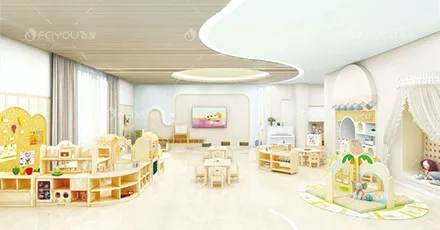
A classroom that feels spacious during morning activities becomes impossibly crowded after lunch, when cots are unfolded and every square foot matters. Another program has ample storage space but finds chairs wobbling after just two years of daily use. These are not hypothetical frustrations — they are the real-world consequences of choosing between stackable and fixed furniture without understanding the trade-offs.
Stackable furniture and fixed furniture each serve different operational needs. Stackable chairs and tables can be piled vertically during non-use hours, potentially freeing up floor space. Fixed furniture, with its permanently attached legs and solid construction, offers predictable stability and no daily setup time.
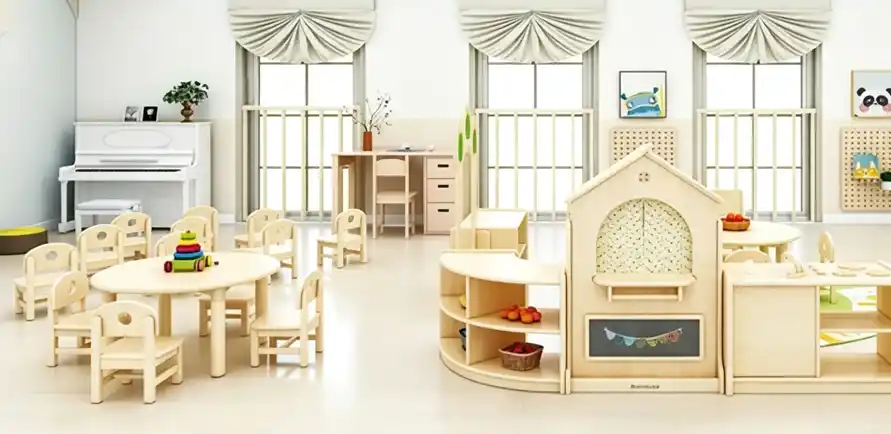
This guide examines the practical differences between these two approaches across five key dimensions: space efficiency, durability, stability, cleaning, and total cost of ownership. By the end, you will have a clear framework for deciding which type — or which combination — best serves your program‘s specific needs.
What Are the Core Differences?
Before diving into detailed comparisons, it helps to understand the basic definitions and typical use cases.
Stackable furniture features chairs with tapered leg designs that nest inside one another and tables with folding or removable legs, allowing multiple units to be stored vertically in a compact footprint. This category is most common in:
-
Multi-purpose rooms that transition between meal times, play times, and rest periods
-
Programs operating in shared spaces (community centers, churches, rented facilities)
-
Classrooms with limited dedicated storage areas
Fixed furniture has legs permanently attached, typically with cross-bracing or reinforced joints. Tables often feature fixed-height legs or adjustable leg designs that remain attached. This category dominates in:
-
Dedicated early childhood classrooms with consistent daily layouts
-
Programs prioritizing maximum stability for young children
-
Facilities where furniture is rarely or never moved
Hybrid approaches also exist: some classrooms use fixed tables (for stability during activities requiring fine motor control) alongside stackable chairs (for flexibility during transitions), or vice versa.
What this means for your program: Very few early childhood programs use exclusively one type. Most successful classrooms employ a mix — for example, fixed activity tables in dedicated learning zones and stackable seating for group gathering areas. The key is understanding which spaces in your facility benefit most from each type.
To understand how your classroom layout and age mix influence furniture decisions, see our guide on classroom planning for different learning zones.
Space Efficiency — The Primary Advantage of Stackable Furniture
The most frequently cited reason for choosing stackable furniture is space savings. In early childhood programs where every square foot must serve multiple purposes, the ability to clear floor space quickly matters.
Quantifying the space savings:
| Furniture Type |
Storage Footprint (20 chairs) |
Daily Setup Time |
Floor Space During Storage |
| Fixed chairs |
60–80 sq ft (arranged in rows) |
None (remain in place) |
60–80 sq ft |
| Stackable chairs (floor stack) |
12–18 sq ft (stacked 5–6 high) |
5–10 minutes |
12–18 sq ft |
| Stackable chairs (storage cart) |
6–8 sq ft (vertical cart) |
3–5 minutes |
6–8 sq ft |
Stackable chairs on purpose-built storage trolleys maximize space efficiency. Universal storage trolleys can hold approximately 10 to 25 stacked chairs, depending on chair design, and reduce the storage footprint significantly compared to fixed chairs arranged in rows.
When space efficiency matters most:
-
Pack-away nurseries: Facilities that must completely clear a room between sessions (morning program vs. afternoon program) benefit enormously from stackable furniture.
-
Multi-purpose rooms: Spaces used for parent meetings, community events, or weekend programs benefit from the ability to completely reconfigure the room in minutes.
-
Small classrooms: In compact spaces, stackable furniture can help free up valuable floor area, such as when converting a play area into a resting space with cots.
When fixed furniture makes sense:
-
Dedicated learning zones: A block-building area or art zone will never need to be cleared. Fixed furniture provides consistent placement that children learn to navigate.
-
Permanent staff work areas: Teacher desks, assessment tables, and storage areas benefit from fixed furniture that does not shift position.
-
Outdoor furniture: Stacking mechanisms exposed to weather degrade faster than fixed designs.
What this means for your program: If your program operates in a dedicated early childhood space with a consistent daily layout, the space-saving advantage of stackable furniture may not justify the extra cost. If you share space or regularly reconfigure your room, stackable furniture may transform how you use your facility.
Durability and Longevity — What Predicts Furniture Lifespan?
Durability considerations differ significantly between stackable and fixed furniture — not because one type is inherently more durable, but because they fail in different ways.
Stackable furniture durability factors:
Stacking chairs typically have a lighter-weight design to facilitate lifting and stacking. This can compromise longevity unless the manufacturer uses engineering-grade materials. The chair‘s structure must withstand not only daily sitting but also the stresses of being lifted, carried, and stacked repeatedly.
Key durability indicators for stackable furniture include:
| Feature |
What to Check |
Why It Matters |
| Leg taper design |
Graduated stacking lugs that engage fully |
Prevents leg deformation over time |
| Shell material |
Durable polypropylene |
Resists impact and cleans easily |
| Glide material |
Replaceable nylon or rubber over molded-in plastic |
Worn glides lead to floor damage and instability |
| Stacking alignment |
Positive locking mechanism, not friction fit |
Friction-only designs wear out after 3–5 years |
Fixed furniture durability factors:
Fixed furniture trades portability for structural simplicity. Without stacking stresses or moving parts, fixed furniture has fewer failure modes. However, joint quality matters enormously.
Solid wood generally holds fasteners better than engineered wood products and is more hardwearing — especially for items that will be moved frequently. Fixed tables with corner bracing, mortise-and-tenon joinery, and quality fasteners can easily outlast stackable alternatives by 5–10 years.
Typical lifespan comparison (daily heavy use):
| Furniture Type |
Typical Lifespan |
Primary Failure Mode |
Repairability |
| Stackable chairs (commercial-grade) |
8–12 years |
Leg deformation, stacking alignment wear |
Moderate (replacement glides available) |
| Stackable chairs (budget-grade) |
3–5 years |
Shell cracking, fastener loosening |
Low |
| Fixed chairs (commercial-grade) |
12–15+ years |
Seat wear, finish scratching |
High (can be refinished) |
| Fixed tables (commercial-grade) |
15–20+ years |
Surface wear, leg joint loosening |
High (can be tightened, refinished) |
What this means for your program: If you prioritize 10+ year replacement cycles and have staff capacity for periodic maintenance (tightening fasteners, refinishing surfaces), fixed furniture offers better value. If you need to reconfigure frequently and value lighter weight over maximum longevity, stackable furniture is appropriate — but purchase commercial-grade, not budget-grade.
To explore furniture designed for long-term durability and safety, see our collection of wooden daycare furniture, which emphasizes solid wood construction and reinforced joinery.
Stability and Safety — Regulatory Standards for Early Childhood Furniture
Stability is a critical safety consideration, and established standards exist to ensure classroom furniture is safe for young children. International and European standards like EN 1729 specify safety requirements and test methods for chairs and tables used in educational institutions, including kindergartens and childcare centers.
Key requirements of EN 1729 for early childhood furniture:
| Requirement Category |
What It Specifies |
Why It Matters |
| Functional dimensions (EN 1729-1) |
Seat height, seat width, lumbar position, backrest angle |
Ensures children can sit with feet flat, knees at 90 degrees — directly supporting posture and fine motor development |
| Safety requirements (EN 1729-2) |
Rounded corners, smooth edges, no hazardous protrusions |
All edges and corners that a user may contact must be smooth, rounded or chamfered — no sharp corners or burrs |
| Strength and durability testing |
Structural integrity under repeated use |
Chairs are tested to withstand loads and forces typical in active classroom environments |
Understanding EN 1729 edge and corner requirements:
EN 1729-2 mandates that any edges and corners with which a user may come into contact during normal use must be smooth, rounded, or chamfered, with no burrs or sharp elements. This applies to tables, chairs, and all accessible furniture surfaces. While the standard is the authoritative source on specific radius measurements, furniture that meets EN 1729-2 will have passed rigorous safety testing for these hazards.
For further evaluation, ISO 7173 specifies test methods for determining the strength and durability of chairs and stools, which can help you compare durability claims across different manufacturers.
What this means for your program: Always request EN 1729 compliance documentation from any furniture supplier. This certification provides assurance that the furniture has passed established safety and durability tests.
Cleaning and Sanitization — Practical Realities for Both Types
Early childhood programs sanitize furniture daily — sometimes multiple times per day. Cleaning protocols differ significantly between stackable and fixed configurations, affecting labor time and product longevity.
Standard child care sanitization protocols require cleaning with soap and water to physically remove dirt and contamination, followed by sanitizing with an approved solution. The U.S. Centers for Disease Control and Prevention (CDC) recommends a chlorine bleach solution for sanitizing purposes in early childhood settings. A common guideline from health authorities for sanitizing is 1/4 cup of regular household bleach to 1 gallon of clean water (or 1 tablespoon to 1 quart of water).
| Cleaning Factor |
Stackable Furniture |
Fixed Furniture |
| Surface cleaning |
Must clean before stacking to prevent cross-contamination |
Clean in place |
| Stacked cleaning |
Need to unstack, clean all surfaces, dry completely before restacking |
N/A |
| Labor time (20 chairs) |
Higher (unstack, clean each, dry, restack) |
Lower (clean in place) |
| Material compatibility |
Polypropylene holds up well to bleach solutions |
Sealed wood may require more careful cleaning |
| Hidden contamination risk |
Interiors of stacking lugs may trap moisture |
Minimal |
Polypropylene stacking chairs are often described as easy to clean, with their non-porous surfaces resisting stains and bacteria buildup. Wood furniture, by contrast, requires a high-quality, water-resistant finish to withstand frequent cleaning with bleach solutions.
What this means for your program: The additional labor for cleaning stackable furniture is real — and can be significant over time. If you have a dedicated classroom with a fixed layout, the ongoing cleaning labor may outweigh the occasional benefits of space-saving.
Total Cost of Ownership — Beyond the Purchase Price
Upfront prices tell only part of the story. A comprehensive total cost of ownership (TCO) comparison considers purchase price, expected lifespan, maintenance costs, cleaning labor, and shipping/storage efficiency.
Five-year TCO factors to consider (20-chair classroom example):
| Cost Category |
Stackable (Commercial) |
Fixed (Commercial) |
| Initial purchase (20 chairs) |
$1,200–2,000 |
$900–1,500 |
| Initial purchase (4 tables) |
$600–1,000 |
$500–800 |
| Cleaning labor (5 years) |
Higher ongoing labor |
Lower ongoing labor |
| Replacement parts (glides, etc.) |
$100–200 |
$0–50 |
| Expected replacement year |
Year 8–12 |
Year 12–15+ |
Stackable furniture offers potential savings in shipping (more units per container) and storage space, which may be significant for programs with expensive real estate. However, the additional daily labor cost can offset these savings over time.
Independent standards for evaluating durability:
What this means for your program: Request ISO 7173 test results or EN 1729 certification from any supplier. These third-party validations allow you to compare durability across manufacturers, regardless of whether the furniture is stackable or fixed.
For programs planning significant furniture investments, detailed planning resources are available to support your facility decisions for layout planning and facility configuration.
Two Classroom Scenarios — Matching Type to Context
Scenario A: A church-based preschool operating in a multi-purpose fellowship hall
This program uses the same room for Sunday services, Wednesday night dinners, and weekday preschool. All furniture must be completely cleared by Friday afternoon and set up again Monday morning.
Recommended approach: Stackable chairs on rolling storage carts (two carts for 30 chairs, stored in a corner closet) plus folding tables on wall-mounted racks. Fixed furniture is impractical here because the room has no dedicated classroom identity. The daily setup and cleanup are acceptable given the space-sharing constraints.
Scenario B: A dedicated early childhood center with four age-specific classrooms
This program has separate rooms for infants, toddlers, preschoolers, and pre-K. Each room maintains a consistent layout that children learn to navigate. Teachers never need to clear the entire floor.
Recommended approach: Fixed tables in all learning zones (art, manipulatives, sensory) for maximum stability. One set of stackable chairs per classroom stored in a closet for occasional large-group activities, but the daily-use chairs are fixed. The modest upfront savings of all-stackable do not justify the daily labor cost and reduced stability.
From Comparison to Selection
By now, you have a comprehensive framework for choosing between stackable and fixed daycare furniture. You understand that space efficiency is the primary advantage of stackable designs, but that stability and cleaning labor often favor fixed furniture. You know that total cost of ownership depends on lifespan and staff time as much as purchase price. And you recognize that most successful classrooms use a hybrid approach — not a single type.
Your next steps:
-
Map your classroom‘s daily and weekly layout changes — how often must furniture move?
-
Calculate your usable floor space — does clearing furniture meaningfully increase available area?
-
Audit your cleaning protocols — does stackable furniture add significant ongoing labor?
-
Request EN 1729 certification and, if possible, ISO 7173 test results from any supplier
-
Consider a hybrid approach: fixed tables in learning zones + stackable chairs for group gathering
With these decision factors clarified, comparing specific product lines from any manufacturer becomes straightforward. You can now evaluate furniture collections based on how well their weight, stacking mechanism, joint construction, and material compatibility align with your program‘s specific space needs and operational constraints.
Related Reading
-
Sharp Edges? Fix Kindergarten Furniture Safety
-
Emergency Preparedness: How Furniture Choice Affects Evacuation Speed and Safety
-
From Crib to Pre-K: How Furniture Needs Evolve as Your Childcare Program Grows
-
Stacking Furniture in Small Home Daycares: Safety Risks with Toddlers Climbing
-
Understanding Early Childhood Furniture Safety Certifications (ASTM, TUV, EN 1729)






 English
 Español