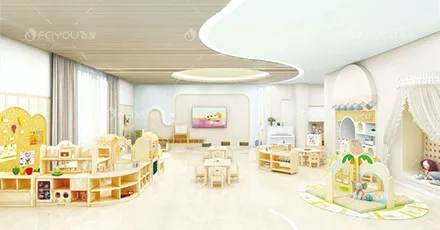
Purchasing wood furniture for a kindergarten or daycare is not the same as outfitting an office or a home. The users are children aged 0–6, who climb, chew, pull, and push furniture in ways adults never would. A single overlooked specification—a sharp edge, a poorly sized gap, or an unverified coating—can become a serious safety hazard that surfaces weeks after installation.
This guide presents seven questions that should be answered before any preschool wood furniture purchase. Each question targets a specific area where suppliers commonly fall short, and each is grounded in current mandatory standards and documented market failures.
Question 1: Can the Supplier Provide a Test Report for GB 28007-2024 Compliance?
The most fundamental question is whether the furniture actually meets China's mandatory standard for infant and children's furniture. GB 28007-2024 took effect on January 1, 2026, replacing the previous version and expanding coverage to the full 0–14 age range—including infants and toddlers who were not adequately protected under earlier standards.
What should you look for? A CMA/CNAS-accredited third-party test report covering the specific product type you are purchasing—not a generic certificate. Government procurement notices for kindergarten furniture routinely require suppliers to provide original test reports that are verifiable online, with the product material matching the tender specifications exactly.
A 2025 comparative test by the Beijing Consumers' Association found that only 4 out of 20 children's furniture samples met all safety requirements, with 15 samples having missing or incomplete warning labels. This suggests that compliance cannot be assumed—it must be verified through documentation.
For an overview of how quality assurance and compliance testing are structured in preschool furniture production, explore the quality assurance framework that guides testing protocols.
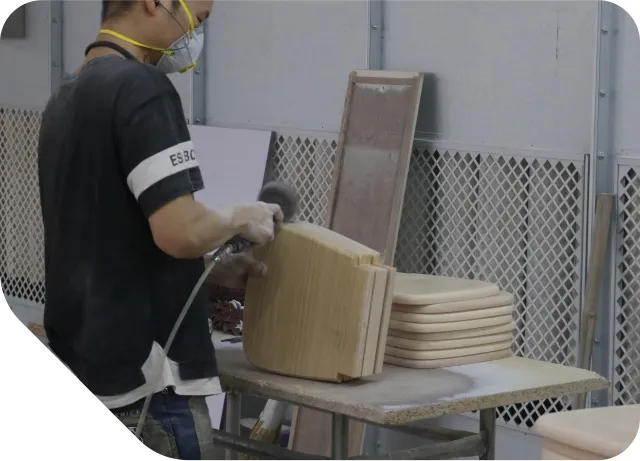
Question 2: Are All Accessible Edges and Corners Properly Rounded?
Edge and corner safety is where many products fail, and it is one of the easiest things to verify during a supplier evaluation.
GB 28007-2024 requires that all accessible edges and corners below 1,600 mm from the floor be rounded or chamfered, with a rounded corner radius of at least 10 mm, or an arc length of at least 15 mm. This is not a suggestion—it is a mandatory requirement.
Why does the specific radius matter? A sharp corner concentrates impact force on a tiny area, producing a deep laceration even from a moderate collision. A 10 mm radius spreads that force over a larger surface, reducing injury severity. During inspection, ask for the actual measured radius—not just a claim that corners are “rounded.”
The same standard prohibits any hazardous sharp edges or points on accessible surfaces, including after mechanical performance testing. This means the edges must remain safe even after the furniture has been subjected to load, impact, or repeated use.
Question 3: What About Holes, Gaps, and Entrapment Risks?
Small fingers and small gaps are a dangerous combination. GB 28007-2024 specifies that holes deeper than 10 mm must have diameters between 6 mm and 12 mm—small enough to prevent finger insertion but large enough to allow ventilation if a finger does become lodged.
This is a surprisingly common failure point. The 2026 Beijing Consumers' Association test identified products with holes measuring between 7–12 mm—precisely the range that can trap children's fingers. Other reported failures included improper gaps that could cause pinching or entrapment.
Beyond holes, the standard also addresses accessible clearances and gaps that could trap limbs or clothing. During evaluation, a simple test is to check whether any opening larger than 6 mm but smaller than 12 mm could allow a finger to enter but not withdraw easily.
Question 4: What Are the Formaldehyde and Heavy Metal Levels?
Wood furniture for children must meet strict limits on hazardous substances. The relevant mandatory standard is GB 18584-2024 “Limit of Harmful Substances in Furniture,” which took effect on July 1, 2025.
Formaldehyde limits have been significantly tightened. Under the new standard, the formaldehyde emission limit is ≤0.08 mg/m³ using the climate chamber method—a substantial reduction from the previous limit of 1.5 mg/L under the desiccator method.
Migratable heavy metals are another critical concern. GB 18584-2024 regulates eight elements including lead, cadmium, chromium, and mercury. For children's furniture, these limits apply to all accessible coating areas—not just colored paints—reflecting the reality that children mouth and touch all surfaces.
When evaluating suppliers, request a CMA-accredited test report specifically covering formaldehyde, TVOC, and migratable heavy metals for the exact product being purchased. A 2026 industry report on children's bedding found lead content exceeding limits by more than 10 times in some samples, underscoring that this is not a theoretical risk.
Question 5: Is There Mandatory Anti-Tip Protection?
Tall cabinets and storage units pose a serious tip-over risk in preschool environments. GB 28007-2024 requires that tall cabinets and similar furniture include permanent wall attachment hardware as a mandatory safety feature—not an optional accessory.
The standard also specifies that anti-tip testing must be conducted for furniture above a certain height threshold to verify stability under load.
In practice, this means:
-
Wall attachment brackets or straps must be included with the product—not sold separately
-
The hardware must be designed for permanent installation, not temporary restraint
-
Installation instructions must clearly indicate the attachment requirement
Government procurement specifications for kindergarten furniture now routinely require stability test reports confirming compliance with furniture mechanical performance and anti-tip standards.
Question 6: Are Warning Labels and Usage Instructions Complete?
Warning labels and age-appropriate usage instructions are mandatory requirements that are often overlooked during procurement.
GB 28007-2024 requires specific warning labels for different furniture types:
-
Folding or adjustable devices: “Warning! Be careful of pinching”
-
Tall desks and cabinets: “Warning! To prevent tipping, secure to the wall”
-
Children's high chairs: “Warning: Guardian must not leave during use”
The standard also requires that product labels clearly indicate the applicable age range and that instructions include proper usage and maintenance guidance.
The 2026 Beijing comparative test found that 15 out of 20 samples had missing or incomplete warning labels—making this one of the most prevalent compliance failures in the market.
Question 7: Does the Furniture Remain Safe After Real-World Use?
A product that passes laboratory tests may still develop safety issues under the daily wear and tear of a preschool classroom. The final question is whether the supplier's quality system addresses post-installation safety.
Key considerations include:
Mechanical durability under repeated use. GB 28007-2024 requires that hazardous edges and points must not emerge after mechanical performance testing—including static load, impact, and durability tests. This means the furniture must maintain its safety profile after children have climbed, jumped, and pushed against it repeatedly.
Maintenance and inspection requirements. The Beijing Consumers' Association recommends that facilities conduct monthly inspections of furniture: checking fasteners and locking devices on beds and chairs, inspecting movable guardrails for proper function, verifying that wall attachment hardware remains secure, and looking for emerging sharp edges, splinters, or loose parts.
Material stability over time. Wood moisture content affects dimensional stability and the formation of cracks that could create splinters. Government procurement specifications for kindergarten furniture typically require wood moisture content between 8.0% and 13.0% to ensure that furniture does not warp, crack, or develop hazardous edges as indoor humidity fluctuates.
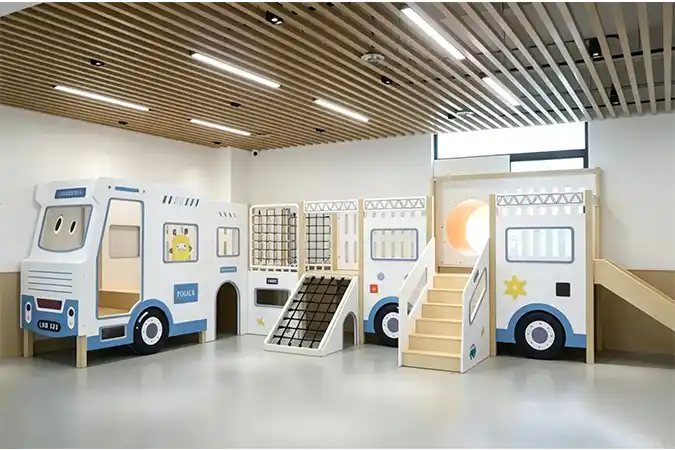
Practical application scenarios:Government-Funded Kindergarten Procurement
Government-funded kindergarten projects represent one of the most demanding procurement scenarios because they must satisfy both mandatory national standards and public accountability requirements.
In these projects, tender specifications typically require:
-
Third-party test reports from CMA/CNAS-accredited laboratories for every furniture type
-
Test coverage including appearance, wood moisture content, wear resistance, and mechanical properties
-
Eight heavy metals testing plus formaldehyde, benzene, toluene, xylene, and TVOC verification
-
Stability test reports confirming no tipping risk
For examples of how safety-compliant furniture is applied in real preschool environments, review the kindergarten furniture project cases that document completed installations.
Next Step: From Compliance Checks to Supplier Assessment
The seven questions above provide a framework for evaluating whether a supplier's products meet minimum safety requirements. But compliance is only the starting point—the next step is assessing whether the supplier can deliver consistently across multiple classrooms, handle replacement parts, and support long-term safety management.
Once you have clarified your compliance requirements and verified that potential suppliers can provide the necessary documentation, comparing specific product specifications becomes the logical next step. For preschool environments with extended daily occupancy and multiple classrooms, you can review FEIYOU's product series—including the Childhood Fort series designed for durability in high-use settings and the Grimm's Fairy-tales series for themed learning environments—or explore whole-garden customization options that address classroom-specific layout and safety requirements.
Related Reading






 English
 Español