A supplier scorecard turns a vague “we liked them” into a comparable number. The useful version has 12 criteria, a clear 1–5 scoring standard, a weighting that reflects the project, and a small set of pass/fail gates that are checked before the weighted score is even calculated. This guide sets out the 12 criteria, how to score each one, how to weight them, and how to use the result to shortlist manufacturers without letting the lowest price decide the outcome.

Why a Scorecard Beats a Gut Feeling
Most buyer teams evaluate suppliers informally. One person prefers the sample, another prefers the price, a third prefers the sales response time. The discussion then drifts toward whoever speaks most confidently.
A scorecard forces the team to agree on criteria before seeing the suppliers, makes each supplier’s strengths and weaknesses visible on the same page, and creates a record that can be defended internally, to a finance team or to a tender committee.
The scorecard is not a substitute for judgement. It is a structure for judgement.
Pass/Fail Gates Before Scoring
Some criteria are not weighted. They are gates. A supplier that fails a gate is excluded regardless of the weighted score.
Typical gates: valid business registration and legal entity confirmed; product-level test reports available for the quoted models; willingness to provide a sample or a sample plan; ability to meet the project’s required delivery window; no unresolved serious quality or compliance complaint in references.
Gates should be few and objective. A gate that depends on opinion becomes a hidden weighting.
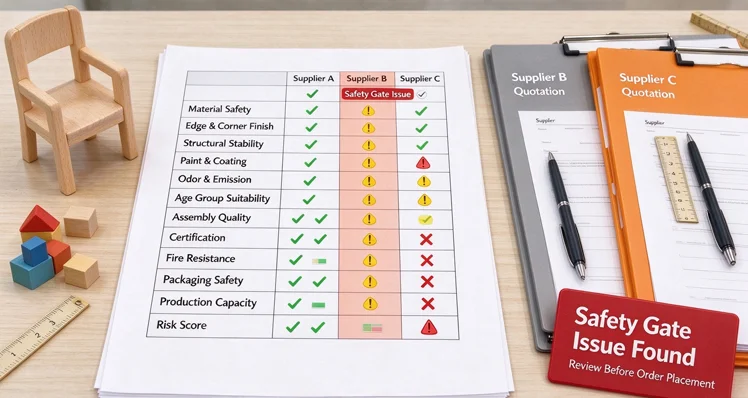
The 12 Criteria
The table below lists the 12 criteria, what each one examines, and a suggested weight range.
| # |
Criterion |
What It Examines |
Suggested Weight Range |
| 1 |
Safety and compliance evidence |
Test reports, standards, model match |
15–20% |
| 2 |
Production capability |
Factory process, equipment, capacity |
10–15% |
| 3 |
Sample quality |
Material, finish, edges, hardware, stability |
10–15% |
| 4 |
Lead time and scheduling |
Production plan, shipping plan, buffer |
8–12% |
| 5 |
Total landed cost |
Unit price plus logistics and duties |
10–15% |
| 6 |
After-sales and spare parts |
Warranty, parts availability, response |
8–12% |
| 7 |
Communication and responsiveness |
Reply time, clarity, technical answers |
5–8% |
| 8 |
References and project experience |
Comparable projects, reference checks |
5–8% |
| 9 |
Packaging and loading |
Protection, marking, container plan |
3–5% |
| 10 |
Customisation capability |
Custom sizes, finishes, themes |
3–8% |
| 11 |
Documentation quality |
Quotation clarity, drawings, manuals |
3–5% |
| 12 |
Commercial stability |
Terms, currency, payment, continuity |
3–5% |
The ranges are starting points. A project with heavy customisation should raise criterion 10. A project importing into a regulated market should raise criterion 1.
How to Score Each Criterion
Each criterion needs a written 1–5 standard. The same standard should be used for every supplier. A simple pattern works: 1 = requirement not met or evidence missing; 2 = partial evidence, significant gaps; 3 = meets the basic requirement; 4 = meets the requirement with clear supporting evidence; 5 = exceeds the requirement with verifiable evidence.
Applied to criterion 1, the standard might read:
| Score |
Safety and Compliance Evidence |
| 1 |
No test reports provided |
| 2 |
Reports provided but do not match the quoted model |
| 3 |
Reports match the quoted model and reference a current standard |
| 4 |
Reports match, standard is current, laboratory is qualified, and the scope is complete |
| 5 |
As score 4, plus additional market-specific documentation and a clear process for updating reports |
The written standard is what makes the scorecard reliable. Without it, two evaluators will read the same supplier differently.
Weighting the Criteria
Weighting is a project decision, not a universal rule. Three examples show how the same 12 criteria can be weighted differently.
| Project Type |
Higher Weight |
Lower Weight |
Reason |
| Public tender |
Safety and compliance, documentation |
Customisation, communication |
Audit and documentation requirements dominate |
| Fast-fit classroom |
Lead time, sample quality |
Customisation, references |
Speed and fit matter more than bespoke design |
| Branded daycare chain |
Customisation, sample quality, references |
Packaging, commercial stability |
Brand consistency and repeatability matter |
The weights should be agreed before supplier responses are opened. Changing weights after seeing the responses undermines the process.
Using the Score
A weighted score is useful only if it leads to a decision. A practical rule set: suppliers below the gate threshold are excluded regardless of score; the low score band is not shortlisted; the middle band is shortlisted for sample review and reference checks; the high band is shortlisted and prioritised for a factory visit or deeper technical review where possible.
The scorecard should not be used to pick a winner on its own. It should be used to decide who deserves the next stage of evaluation.
Common Scoring Biases
Even with a written standard, evaluators drift. The most common biases are price anchoring, sample halo, responsiveness bias, familiarity bias and recency bias.
A simple countermeasure is to have two evaluators score independently, then compare. Where scores differ by more than one point, the evaluators should discuss the evidence, not the impression.
Red Flags That Override the Score
Some findings should stop the process regardless of the weighted total: test reports that do not match the quoted model; refusal to provide a sample or a sample plan; vague or contradictory answers about production location; no written after-sales terms; pressure to pay in full before production; inconsistent quotation versions; references that cannot be reached.
These are gates, not scoring items. They belong at the top of the scorecard, not at the bottom.
How Feiyou Supports Supplier Evaluation
Feiyou works with kindergarten, daycare, and preschool projects and can provide product information, samples for confirmed specifications, and documentation for the quoted models. The project planning process helps structure the scope before evaluation, and the quality assurance process describes inspection controls during production.
You can review the planning process, the quality assurance process, and the workshop page. Product categories for a bill of quantities are available at kindergarten furniture categories and daycare furniture categories.
FAQ
How many criteria should a supplier scorecard have?
Around 10 to 12 weighted criteria plus a small number of pass/fail gates. Fewer criteria miss important differences; more criteria make the process hard to use consistently.
Should price be the highest-weighted criterion?
Usually not. Price matters, but total landed cost and after-sales support often matter more over the life of the furniture. A low unit price can hide higher freight, weaker construction or shorter service life.
Can I use the same scorecard for every project?
The criteria can stay the same, but the weights should change with the project. A public tender and a fast-fit classroom do not value the same things.
What should I do when two evaluators score differently?
Discuss the evidence, not the impression. If the difference is more than one point, ask each evaluator to point to the specific evidence behind the score.
Is a scorecard enough to choose a supplier?
No. It shortlists suppliers. Sample review, reference checks and, where possible, a factory visit remain part of the decision.
Conclusion
A supplier scorecard works when it is built before the suppliers are seen, scored against written standards, and used to shortlist rather than to crown a winner. Twelve criteria cover the main dimensions of supplier capability. A small set of gates protects the process from documents that look complete but do not apply. Weighting should reflect the project, and the score should lead to a clear next step: exclude, shortlist, or review more deeply.
If you are preparing a tender, pair the scorecard with the RFP guide, the specification sheet guide and the test report verification guide. You can review Feiyou’s project planning process, check the quality assurance process, or contact the team to discuss evaluation requirements before the shortlist is set.
Related Reading






 English
 Español