"Tested to EN 71" does not identify a test result. EN 71 is a series of separate toy-safety standards, and a furniture order is covered only when four fields are pinned down in writing: the part number (EN 71-1 mechanical and physical, EN 71-2 flammability, EN 71-3 migration of elements), the edition cited, the laboratory and its accredited scope, and the material-and-colour list the report actually tested. If any one field is missing, the sentence cannot be verified at inspection and cannot be defended in a procurement file. EN 71 is also a toy route: for educational furniture the governing standards are EN 1729-1 and EN 1729-2.
The phrase survives in procurement files because it is short and easy to repeat. A report is not short, and it is not a phrase. It is a document with a scope: a standard part, an edition, a sample, a laboratory, a result per test item. Remove any of those and "tested to EN 71" becomes a claim without a subject.
This is the third check in a short series on certificate verification for furniture procurement. The first covered whether a standard on a certificate governs furniture in your destination market; the second covered the difference between a supplier's certification and a product-level claim. This one goes inside the EN 71 report itself, where the coverage is decided.
EN 71 is more than a dozen parts. Three of them usually matter for furniture
A buyer who treats EN 71 as one document cannot read the report that arrives. The series is built part by part, each with its own scope, methods and edition.
| Part |
What it tests |
What it can prove in a furniture file |
What it cannot |
| EN 71-1 |
Mechanical and physical properties: edges, points, small parts, stability, folding and sliding mechanisms, cords |
That a toy or toy-like component passed the mechanical tests in the edition cited |
Structural adequacy of a classroom table or chair (EN 1729-2 covers that) |
| EN 71-2 |
Flammability of toys, including certain costumes and soft-filled items |
That a specific toy item met the flammability requirements of that part |
Flammability performance of upholstered furniture as furniture |
| EN 71-3 |
Migration of 19 elements (including lead, cadmium, chromium VI, mercury) from toy materials, in three material categories |
That a named coating or material passed migration limits for the category tested — Category III covers scraped-off surface coatings |
Structural safety, dimensions, or any coating not listed in the report's material schedule |
| EN 71-9 / -10 / -11 |
Organic chemical compounds: requirements, sample preparation, methods of analysis |
That specified organic compounds were assessed by the stated method |
Anything about mechanical performance |
| EN 71-12 |
N-nitrosamines and N-nitrosatable substances |
That a rubber or elastomer component met the nitrosamine limits |
Other material risks |
| EN 71-15 to -20 |
Formamide, chlorinated phosphorus flame retardants, isothiazolinones, phenol, bisphenol A, microbiological safety of aqueous media |
Narrow material-specific results |
Whole-product compliance |
| EN 71-7 / -8 / -14 |
Finger paints, activity toys for domestic use, trampolines |
Results for those specific product types |
Classroom furniture |
The practical rule: read the standard column before the results column. A report whose header says "EN 71" and whose standard column is empty has not told you which of these tests it ran, on which materials, to which edition. That is not a conservative document; it is an unreadable one.
The legal boundary: EN 71 is the toy route, EN 1729 is the furniture route
EN 71 exists to support the EU Toy Safety Directive 2009/48/EC. It applies to products designed or intended for use in play by children under 14. Educational furniture is not, as a category, a toy. Its own European standards are EN 1729-1 for functional dimensions and EN 1729-2 for safety requirements and test methods.
That boundary explains a pattern buyers meet constantly: a supplier sends a coating test to EN 71-3 and presents it as proof of furniture compliance. It proves one material property of one coating. It says nothing about seat height, stability under load, tipping resistance, or the safety requirements that EN 1729-2 addresses. Both documents can be valid at the same time and answer different questions — which is why a buyer needs both, not whichever one arrived first.
The same split exists in the United States, with different instruments. ASTM F963 is the mandatory toy safety standard (16 CFR part 1250), and its scope excludes furniture except toy counterparts. For children's furniture, the paint and surface-coating requirement is the one that bites: no more than 90 ppm lead in paint or similar surface coatings under 16 CFR part 1303, and no more than 100 ppm total lead in accessible components under 15 U.S.C. § 1278a. Those are tested at a CPSC-accepted laboratory, and the resulting Children's Product Certificate is issued by the manufacturer or importer — not by the laboratory.
If your team is already working through the standard-to-market question, the earlier check in this series walks through how a certificate's standard may not govern your market at all: Your Supplier's EN 1729 Certificate Won't Save You in a US Project. For the field-level reading of a test report — who signed it, what the sample description says, how limits are expressed — the existing guide covers the anatomy: How to Read and Verify Kindergarten Furniture Test Reports.
The procurement action: in the specification, name the standard and the part, and say what each one is for. A sentence that works: "Surface coatings on all accessible surfaces shall be tested to EN 71-3, Category III, by a laboratory accredited to ISO/IEC 17025 for the method; structural safety shall be assessed to EN 1729-2." Vague requests produce vague reports, and vague reports are the ones that fail at inspection.
Which laboratory: a report needs four identifiers, not a logo
A test result is only as good as the laboratory behind it, and the laboratory is only as good as its accredited scope. Four identifiers convert a PDF into evidence:
- The laboratory's legal name and address, matching the entity on the report's letterhead — not a trading name on the quotation.
- The accreditation body and number (for example CNAS, UKAS or DAkkS) together with the scope page that lists the specific method and the material category tested. ISO/IEC 17025 accreditation is granted per method and per matrix; a laboratory accredited for toy mechanical testing is not thereby accredited for element migration in coatings.
- The report number, issue date, and the edition tested. These three fields are what an auditor checks first, because they decide whether the document is current.
- For US children's products, the laboratory's CPSC-accepted status, which is searchable in CPSC's public laboratory directory. A CPSC-accepted laboratory is not the same as an accredited laboratory, and a CPC built on a non-accepted laboratory's report is a certification defect.
Five signals that a report will not survive an audit:
- The accreditation number is absent, or present without a scope page.
- The "report" is a test plan, a quotation for testing, or a one-page certificate of compliance with no test data.
- The sample description is "furniture sample" with no material or colour list.
- The result page names a different material category than the one your product falls into.
- The laboratory's accreditation covers the method in general but not the matrix you are buying (for example, accredited for plastics but not for coatings on wood).
For buyers who want to see how a manufacturer organises certification, scope statements and batch documentation on the production side, the quality assurance framework at FEIYOU sets it out page by page.
Which colours and finishes: the coverage trap
A test report speaks about a sample. The sample is described in a specific section: substrate, coating system, colour, and sometimes the supplier of each. Coverage is decided there, not in the conclusion paragraph.
Three substitutions quietly move your order outside the report:
| Change |
Why the report no longer covers it |
What to require |
| A new colour in the same paint base |
Pigments change the formulation; migration results are formulation-specific, and the report's material list names the colours tested |
A colour extension report for the new finish, or a written acceptance route in the contract |
| A coating system change (water-based to solvent-based, PU to NC, liquid paint to powder coat) |
Different chemistry, different migration profile, different test category |
A new EN 71-3 test on the new system before shipment |
| A substrate or edge change (MDF to plywood, new edge-banding adhesive, new hardware supplier) |
The tested matrix is no longer the delivered matrix |
Disclosure before shipment plus a batch-consistency declaration |
The check is mechanical, and it takes about twenty minutes: put the report's material-and-colour list beside your purchase order's finish schedule and match line by line. Every finish in the order must appear in the report's list, with the same colour name and the same category. Where a line does not match, the report does not cover it — regardless of how similar the two colours look on a swatch.
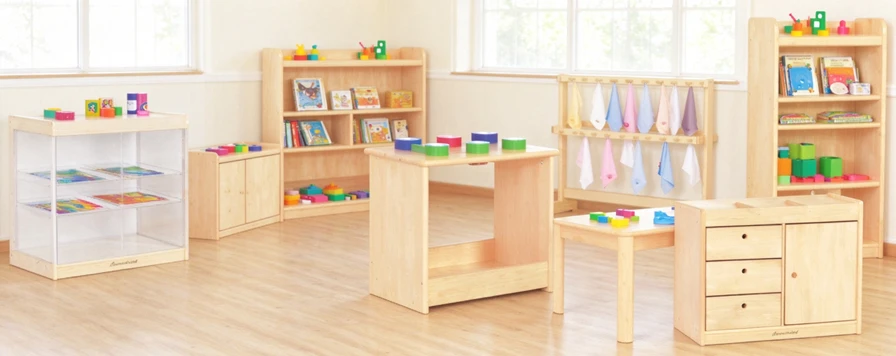
Buyers comparing finish and colour options across product ranges can use the Kindergarten furniture configurations as the starting point for that mapping.
The procurement action: add a colour-and-finish coverage list to the certificate annex, and add a no-substitution-without-notice clause: any change to pigment, coating system, substrate or edge treatment must be disclosed in writing before shipment, with either a test extension or a signed acceptance of the deviation.
Which edition: a 2014+A1:2018 report is now a superseded-edition report
Editions move, and the EN 71 series moved recently. EN 71-1:2026 supersedes EN 71-1:2014+A1:2018, and the older edition was withdrawn on 29 January 2026. EN 71-3:2019+A1:2021 remains the edition in force for element migration, with its three material categories and its 19 elements.
Two consequences matter to a buyer, and neither is about chemistry:
- A report must state the edition. "EN 71-1" alone does not say whether the mechanical tests were run to the 2018 amendment or the 2026 revision. If your acceptance rule does not name an edition, the supplier chooses one for you — usually the one already on file.
- Whether a newer edition is the presumption-of-conformity edition in your market depends on its citation in the Official Journal of the EU. Publication and citation are two different events, and the gap between them is exactly when procurement disputes are born. The contract should name the edition and should state what happens if the edition changes mid-project.
Time is the other variable. Under CPSC rules, most children's products require periodic testing, in many cases annually (16 CFR § 1107.21). An EN 71 report dated four years ago is not automatically invalid, but it is a question rather than a pass: it describes a sample, a formulation, and a supply chain that may no longer exist.
| The report says |
What to check |
The risk if you skip it |
| EN 71-1 (no edition) |
Edition year and amendment |
You may be accepting tests to a withdrawn edition |
| EN 71-3:2019 (no amendment) |
Whether the aluminium limits reflect A1:2021 |
A migration result that no longer matches the cited limits |
| Tested in 2019, sample "as per client's request" |
Sample description, material list, formulation date |
Coverage of a product that has since changed |
| "Certificate of compliance" |
Whether test data exists behind the certificate |
A document with no results to verify |
The procurement action: write a standard-version lock into the contract — the standard number, part and edition used for acceptance — plus a revision transition sentence naming who decides and by when if the edition changes before delivery.
The four-field annex
Everything above collapses into four fields that belong in the certificate annex of the purchase contract. Four fields, because four is what an inspector can check at the door.
| Field |
Wording to place in the annex |
What it closes |
| Part and edition |
"Coating: EN 71-3:2019+A1:2021, Category III. Mechanical: EN 71-1:2026 (or the edition in force at the date of testing, stated on the report). Structural: EN 1729-2." |
The "EN 71" ambiguity and the edition gap |
| Laboratory and scope |
"Report issued by [laboratory legal name], accreditation [body + number], scope covering [method + matrix]; for US-bound children's products, CPSC-accepted laboratory." |
The logo-without-scope problem |
| Report and coverage list |
"Report No. [number] dated [date]; material and colour list attached as Annex A, covering every finish in the PO finish schedule." |
The colour and finish gap |
| Retest and extension triggers |
"Any change of pigment, coating system, substrate, edge treatment or component supplier triggers a new test or a written extension before shipment; report older than 12 months to be re-confirmed." |
Silent substitution and stale evidence |
Attach the four fields to a payment node. A report that is only requested at final inspection has no leverage behind it; a report that releases the deposit has.
If your team is holding a report and a finish schedule that do not obviously match, the FEIYOU quality and product teams can review the coverage line by line before you commit.
FAQ
Does "tested to EN 71" mean the furniture is compliant in the EU?
No. EN 71 is a toy-safety series built to support Directive 2009/48/EC. Educational furniture is governed by EN 1729-1 for dimensions and EN 1729-2 for safety requirements and test methods. An EN 71 report can be entirely valid and still leave the furniture's structural and dimensional requirements untested.
The report only covers EN 71-3. Is that enough for a kindergarten table?
It is enough for one thing: the migration performance of the coatings or materials named in the report, in the category tested. It does not address structure, stability, dimensions, entrapment or tipping. A table needs both a materials test and a furniture-standard assessment.
Which EN 71 part covers paint on a chair?
EN 71-3, migration of certain elements, with surface coatings falling in Category III (scraped-off materials). The report must state the category; a Category II result for a liquid paint is not the same test as a Category III result for the dried film on the chair.
Does the laboratory have to be in the EU?
No. What matters is accreditation to ISO/IEC 17025 for the specific method and matrix, and — for US-bound children's products — CPSC-accepted status. Geography is not the criterion; scope is.
Can I accept a report where one colour in my order is missing from the list?
Not as coverage. The report covers what its material list names. For the missing colour you need either an extension report for that finish or an explicit acceptance route written into the contract before shipment.
How old can an EN 71 report be?
There is no universal expiry, but there are two limits that matter: the edition it cites, and the supply chain it describes. Where a market requires periodic testing — annually for many children's products under CPSC rules — a report older than a year should be treated as needing re-confirmation rather than as a standing pass.
Conclusion
"Tested to EN 71" is a sentence, not a result. The result lives in four fields: which part and which edition, which laboratory and which accredited scope, which report and which material-and-colour list, and which changes trigger a retest.
Buyers who require those four fields before signing are not adding paperwork. They are answering the only question an inspection will ask: does this document describe the goods in this container? A supplier who can answer it in writing has already told you something about how the next four years of that relationship will go.
For procurement teams building EN 71 requirements into a kindergarten or daycare furniture specification, the FEIYOU quality assurance framework documents how certification scope, colour coverage and batch records are handled on the production side.






 English
 Español